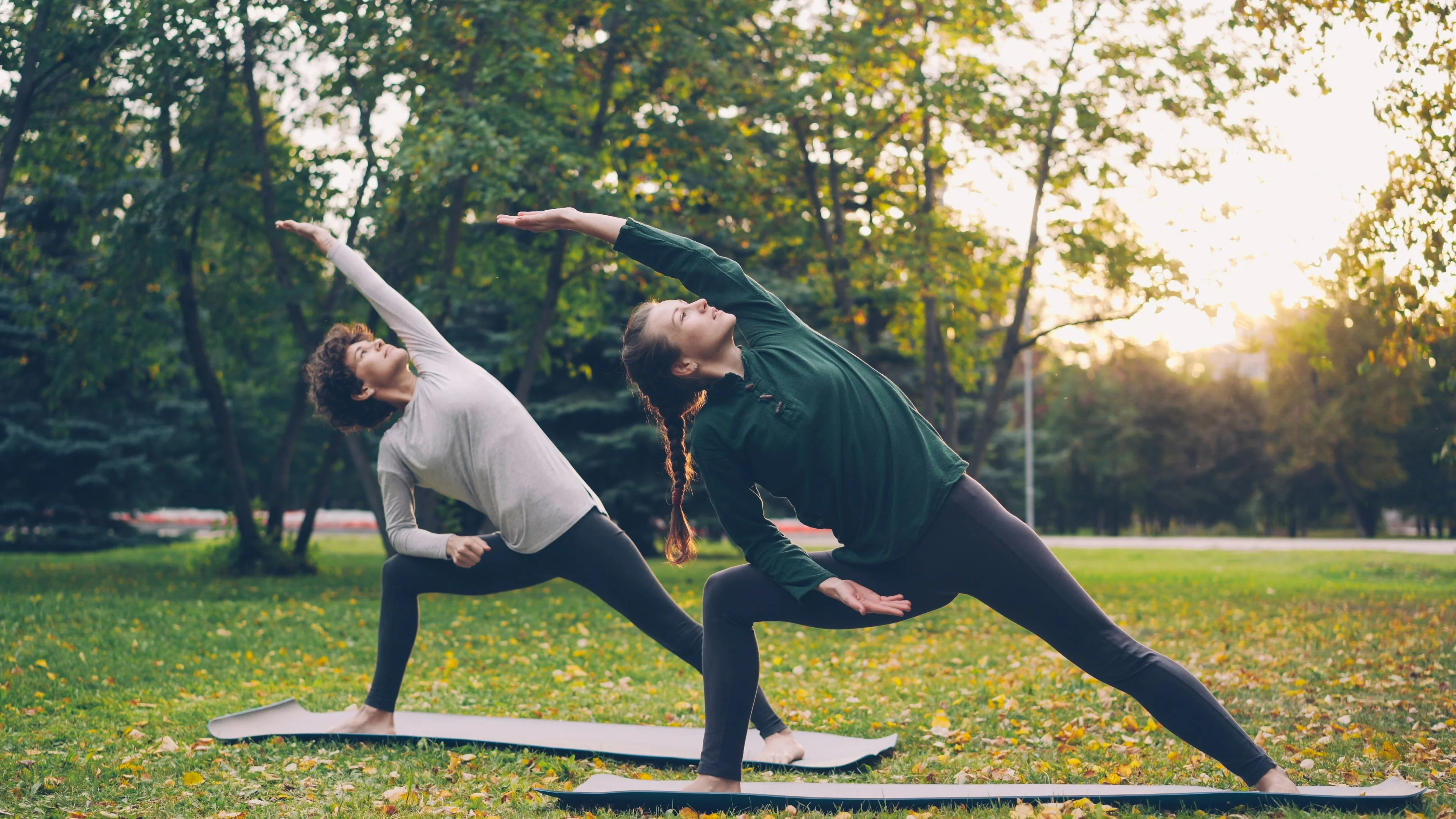
yoga flow
The 13-Pose Morning Flow: Alignment, Breath & Timing for Every Pose
A complete 13-pose morning yoga sequence with detailed alignment cues, breath patterns, and suggested hold times for each pose... from Mountain pose through to Savasana.
Bodhgriha Team
Bodhgriha Institute
There is a particular quality to the body in the first hour after waking ... stiff in places you didn't expect, tender along the spine, slow to receive instruction. This is not a body to be forced into deep practice. It is a body to be coaxed.
The sequence below moves through thirteen poses, beginning on the feet and ending flat on the back, following a logic that mirrors the body's own waking process: standing poses to build heat and stability, a gentle backbend sequence to open the front body, hip and spine work on the floor, and a long, unhurried close. Each pose includes alignment cues, a breath pattern, and a suggested hold time, together, the full sequence takes between 20 and 30 minutes, depending on how long you choose to stay in each shape.
This is a practice you can return to most mornings. Familiarity is part of what makes a morning sequence work... the less you have to think, the more the practice can actually settle you.
Before You Begin
Practice on an empty or nearly empty stomach, ideally before food and coffee. A glass of water on waking is enough. Keep the room warm if possible ... cold muscles resist opening, and there's no benefit to forcing a stretch the body isn't ready for.
1. Mountain Pose (Tadasana)
Begin standing at the front of your mat, feet hip-width apart, arms resting by your sides.
Alignment: Root down evenly through all four corners of each foot. Engage the thighs gently without locking the knees. Lengthen the tailbone down while lifting through the crown of the head, as though a thread were drawing you upward from the centre of the skull. Let the shoulders roll back and down, away from the ears, with the palms facing forward.
Breath cue: Stand for five full breaths. On each inhale, feel the spine lengthen slightly; on each exhale, feel the feet root a little more firmly into the earth.
Hold time: 30–45 seconds.
Mountain pose looks like rest, but it is the foundation every other pose in this sequence depends on. Take the time here to actually arrive in the body before moving on.
2. Warrior II (Virabhadrasana II)
Step the feet wide ... roughly a leg's length apart. Turn the right foot out 90 degrees and angle the left foot in slightly. Bend the right knee until the thigh is roughly parallel to the floor, keeping the knee tracking directly over the ankle.
Alignment: The front knee should never extend past the front ankle... this protects the joint and keeps the pose stable. Square the hips and torso toward the long edge of the mat, not toward the front foot. Extend the arms parallel to the floor, fingertips reaching in opposite directions, gaze soft over the front fingertips.
Breath cue: Inhale as you settle the back heel firmly into the mat; exhale as you sink slightly deeper into the front knee, without losing the line of the front ankle.
Hold time: 5–8 breaths per side (roughly 30–45 seconds each side).
3. Reverse Warrior (Viparita Virabhadrasana)
From Warrior II, on an inhale, flip the front palm to face upward and reach the front arm overhead, allowing the torso to arc backward over the back leg. The back hand can rest lightly on the back leg for support.
Alignment: Keep the front knee bent at the same angle as Warrior II ... don't let it straighten as you reach back. The side-body opening should come from length through the ribs, not from collapsing into the lower back. Keep both legs as active as they were in Warrior II.
Breath cue: Inhale to lift and lengthen through the side body; exhale to stabilize through the legs and root the back foot.
Hold time: 3–5 breaths per side.
This pose offers the first real opening of the morning sequence ... a release through the side body and the breath that prepares you for the deeper stretch coming in Triangle.
4. Triangle Pose (Trikonasana)
From Warrior II, straighten the front leg. Reach the front arm forward, hinge at the hip, and lower the front hand to the shin, ankle, or a block ... wherever you can reach without rounding the spine. Extend the back arm straight up toward the ceiling.
Alignment: The hinge happens at the hip joint, not the waist, keep the torso long and the chest open, stacking the shoulders vertically rather than rolling the top shoulder forward. Both legs stay active and engaged. Gaze can be toward the top hand, or down toward the floor if that's more comfortable for the neck.
Breath cue: Inhale to lengthen the spine before the hinge; exhale to fold; once in the pose, take 4–5 breaths, using each inhale to create more length and each exhale to deepen slightly without forcing.
Hold time: 5 breaths per side (roughly 30 seconds each side).
After completing Warrior II through Triangle on one side, return to Mountain pose and repeat poses 2 through 4 on the second side before continuing.
5. Downward Dog (Adho Mukha Svanasana)
From standing, fold forward and step or walk the feet back into an inverted V-shape, hands shoulder-width apart, feet hip-width apart.
Alignment: Press firmly through the palms, spreading the fingers wide, with the index finger pointing forward. Draw the hips up and back, lengthening the spine. The heels do not need to touch the floor ... keep a slight bend in the knees if the hamstrings are tight, prioritizing spinal length over straight legs.
Breath cue: Use this pose to settle into a steady rhythm... five long breaths, allowing each exhale to soften the shoulders away from the ears and lengthen the spine a fraction more.
Hold time: 5–8 breaths (roughly 30–45 seconds).
6. Cobra Pose (Bhujangasana)
Lower down onto the belly. Place the palms flat on the mat beneath the shoulders, elbows hugging in close to the ribs. Press the tops of the feet into the mat.
Alignment: Lift the chest using the strength of the back muscles, not by pushing hard through the hands. Keep the elbows slightly bent rather than locking them straight ... this is a gentler, more sustainable version of the backbend. Keep the shoulders away from the ears and the lower ribs grounded, rather than collapsing weight into the lower back.
Breath cue: Inhale to lift the chest; hold for 2–3 breaths in the shape; exhale to release back down.
Hold time: 15–20 seconds, repeated 2–3 times with a breath of rest between each lift.
Cobra is the gentlest of the backbends in this sequence and a good entry point for a body that is still waking up ... Updward Dog (a deeper variation) is not included here intentionally, in favour of this more accessible shape.
7. Pigeon Pose (Eka Pada Rajakapotasana)
From all fours, bring the right knee forward toward the right wrist, angling the right shin diagonally across the mat. Extend the left leg straight back behind you, top of the foot on the mat.
Alignment: Keep the hips squared toward the front of the mat as much as the body allows ... it's common for the back hip to roll open, so actively draw it back toward center. You can stay upright on the hands or fold forward over the front shin, resting on the forearms or a stacked pile of blocks/cushions if the hip is tight.
Breath cue: This is a hold-and-release pose .. once settled, take 6–8 slow breaths, using each exhale as an invitation to soften the hip rather than push it.
Hold time: 45–60 seconds per side.
After completing Pigeon on the right side, return to all fours and repeat on the left before continuing to the next pose.
8. Half Lord of the Fishes (Ardha Matsyendrasana)
Come to a seated position. Extend the left leg straight, bend the right knee and place the right foot flat on the floor outside the left thigh. Inhale to lengthen the spine; exhale to twist toward the right, using the left elbow against the outside of the right knee for leverage, or simply placing the left hand on the right knee.
Alignment: The twist should originate from the base of the spine, moving sequentially upward through the lower back, mid-back, and finally the neck ... avoid twisting only from the shoulders. Keep both sitting bones grounded evenly, resisting the urge to lean back as you twist.
Breath cue: Inhale to find length in the spine; exhale to deepen the twist slightly. Take 5 breaths per side, using each exhale to rotate a little further without strain.
Hold time: 30–45 seconds per side.
Twists are traditionally associated with detoxification and digestive stimulation, making this an especially fitting pose for a morning sequence ... it wakes the abdominal organs alongside the spine.
9. Seated Forward Bend (Paschimottanasana)
Extend both legs straight in front of you. Inhale to lengthen the spine upward; exhale to hinge forward from the hips, reaching for the feet, ankles, or shins ... wherever you can comfortably reach.
Alignment: As in Triangle pose, the forward fold should hinge at the hip joint rather than rounding through the lower back. If the hamstrings are tight, keep a generous bend in the knees and focus on lengthening the spine rather than reaching the hands further down the legs. Let the head and neck relax rather than straining to look forward.
Breath cue: This is a slow pose. Inhale to lengthen; exhale to fold a little deeper. Stay for 6–8 breaths, allowing the body to release incrementally with each exhale rather than forcing the fold all at once.
Hold time: 45–60 seconds.
10. Happy Baby Pose (Ananda Balasana)
Lie on your back. Bend both knees toward the chest and grab the outside edges of the feet (or the ankles, or behind the thighs, depending on flexibility), opening the knees wide toward the armpits.
Alignment: Keep the lower back and tailbone grounded against the mat rather than lifting off the floor. The shins should be roughly perpendicular to the floor. Gently rock side to side if it feels good ... this is a pose that rewards a small amount of playful movement.
Breath cue: Slow, even breaths, allowing the lower back to soften into the mat on each exhale. Stay for 6–8 breaths.
Hold time: 30–45 seconds.
This pose offers a gentle counter-stretch to the forward folds and twists that precede it, opening the hips and lower back in a different direction.
11. Figure Four Stretch
Still on your back, cross the right ankle over the left thigh, just above the knee, creating a figure-four shape with the legs. Thread the hands behind the left thigh (or shin) and draw the legs gently toward the chest.
Alignment: Keep the crossed ankle flexed (rather than pointed) to protect the knee joint. Press the right knee gently away from you with the right forearm if you want a deeper stretch through the outer right hip. Keep the head and shoulders relaxed on the mat throughout.
Breath cue: Long, slow breaths, 6–8 total, using each exhale to invite a little more release through the outer hip and glute.
Hold time: 45–60 seconds per side.
This targets the piriformis and outer hip rotators directly ... areas that hold significant tension from both sitting and standing postures, making it a valuable addition even on days when time is short.
12. Knee to Chest (Apanasana)
Draw both knees in toward the chest simultaneously, wrapping the arms around the shins or behind the thighs.
Alignment: Keep the lower back gently pressed into the mat. You can keep the head down, relaxed on the floor, or lift slightly to draw the forehead toward the knees for an additional gentle release through the upper back.
Breath cue: This is a settling pose. Five slow breaths, with each exhale encouraging the whole spine to soften further into the mat.
Hold time: 30–45 seconds.
13. Corpse Pose (Savasana)
Release the legs flat onto the mat, feet falling open naturally, arms resting a few inches from the body, palms facing upward.
Alignment: There is, in a sense, no alignment to correct here, the invitation is simply to let the body be fully supported by the floor. Allow the lower back to soften, the jaw to unclench, the eyes to rest gently closed.
Breath cue: Let the breath return to its natural, unforced rhythm. No counting, no directing, simply observing.
Hold time: 3–5 minutes minimum. If your morning allows it, longer is always better here.
Bringing the Sequence Together
A full pass through this thirteen-pose sequence, including both sides of the asymmetrical poses, takes roughly 20 to 30 minutes, depending on how long you linger in each hold. On mornings with less time, you can shorten the holds rather than cutting poses; even a sequence moved through briskly, breath by breath, retains its structural logic.
What makes a sequence like this valuable over time isn't any single pose. It's the cumulative effect of returning to the same shapes morning after morning ... noticing, gradually, where the body has opened, where it still resists, and how the breath changes from one week to the next. That noticing is, in its own quiet way, the actual practice.
Last updated June 21, 2026 at 20:03 UTC